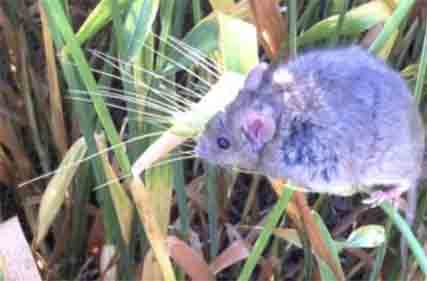
 Grain growers in Victoria and South Australia are advised to be on alert for increased mouse activity, with significant economic damage at sowing expected in some areas.
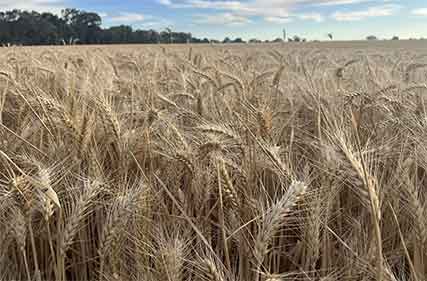
Recent monitoring efforts funded by the Grains Research and Development Corporation (GRDC) indicate that mouse abundance is on the rise across both States, fuelled by ample food and cover as a result of last year’s bumper harvest.
CSIRO researcher Steve Henry, who has been surveying mouse activity for a GRDC-funded project, says mouse abundance is increasing on South Australia’s northern Adelaide Plains and Yorke and Eyre Peninsulas, while a build-up in numbers is occurring at all monitored locations in Victoria’s grain belt.
With mice continuing to breed, Mr Henry expects that populations will rise further in the lead-up to sowing of this year’s winter crops.
“Growers should remain vigilant and act accordingly if damage is likely,” Mr Henry says.
Mr Henry has observed unexplained variability in mouse activity from one paddock to the next on some properties, and therefore advises growers to monitor across multiple paddocks to get a true indication of numbers to inform their management decisions.
He recommends growers look for evidence of active burrows, rather than relying on mouse chew cards as these are not as effective when abundant alternative food is present.
“To look for active burrows, I suggest farmers walk about 30 metres in from the edge of the paddock and set a 100 metre (1 metre wide) transect through a crop, following the furrows.
“They should walk slowly along the transect scanning for evidence of mouse burrows, taking note of any burrow that looks active and recording the number of burrows per 100 metre transect, and then repeat across two or four transects.
“If there are more than two to three active burrows per 100 metres, then they have a mouse problem.” Mr Henry says corn flour can be used to mark potentially active burrows, but the transect will need to be inspected the next day for observation of signs of activity.
In terms of zinc phosphide baiting, Mr Henry recommends the following:
• Apply bait according to the label;
• Apply baits six weeks prior to sowing if there is sufficient
evidence to bait (if planning to bait only once, then bait at
sowing);
• Allow at least four to six weeks before re-application of baits to
minimise the chance of bait aversion. This allows mice that
have previously tried the bait to try it again and also targets
news animals in the population that are susceptible to the bait;
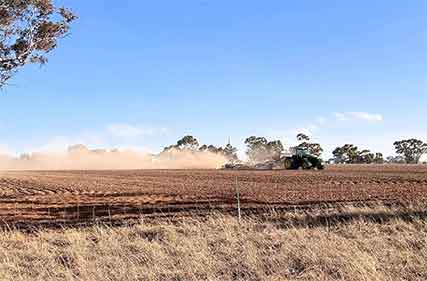
• If baiting at sowing, apply directly after sowing (e.g. bait
spreader on the back of the seeder). Mice increase foraging
activity after sowing because of the soil disturbance. If a novel
food is available on the surface they will eat that in preference
to digging up the planted seed. Baiting more than 24 hours
after sowing will not be as effective;
• Bait over large areas. Encourage neighbours to bait at the
same time if they also have a mouse problem. The larger the
area treated, the lower the chance of re-invasion post
treatment.