Avoiding the cost of building new transmission does not lower consumers’ electricity bills.
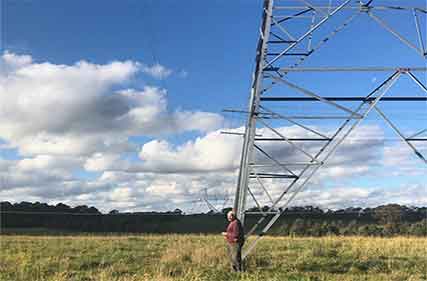
New transmission lines are a hot topic with politicians, companies and farmers all weighing in on the right path forward.
The large power lines are an important part of Australia’s move away from coal power and towards cleaner energy sources, but exactly where and how they are constructed is being debated widely, with several parliamentary inquiries also currently underway.
Associate Professor Roger Dargaville, Deputy Director Monash Energy Instituteis an expert in renewable energy technologies, energy systems and markets as well as climate change. He works in the Civil Engineering department at Monash University and the Monash Energy Institute.
Roger Dargaville said building new transmission infrastructure is absolutely key because at the moment, it’s probably the single biggest bottleneck to getting more renewables connected to the grid, especially in Victoria and South Australia.
“We have to build new transmission lines to get power from new wind and solar projects to the load centres where the power is used. It is equally critical that communities have agency in the discussions about where the transmission lines go, who is impacted, and what kind of compensation is offered. Projects should be developed in partnership with communities rather than simply being imposed on them. Communities need to be actively engaged in the projects and be properly compensated so that the best outcomes can be found.”
Tim Buckley, Director Climate Energy Financeis a respected energy market analyst, with more than 30 years’ experience in Australian and international financial markets. Climate Energy Finance (CEF) is a non-partisan think tank established in 2022 that works pro bono in the public interest on accelerating decarbonisation in line with climate science.
Tim Buckley said Climate Energy Finance views modernisation and reconfiguration of Australia’s interstate electricity grid transmission as a key enabling investment that will increase grid reliability, enable decarbonisation and lock in permanently lower electricity prices over time due to the deflationary nature of the firmed renewable energy capacity the grid will facilitate.
“While the grid transmission is expensive and slow to build, and is seeing significant community backlash, we see transmission as a prerequisite to the electrification of everything and decarbonisation of the Australian energy market. This in turn builds Australia’s international competitiveness, particularly as carbon prices must invariably be priced into global trade to deliver on the Paris Agreement and reduce the climate crisis increasingly evident across the globe.
“Australia stands to be a renewable energy powered superpower, exporting embodied decarbonisation, but that will involve deployment of over $100-200bn of new investment in transmission, smart grid operations, batteries for firming, utility and distributed renewable energy resources, plus batteries on wheels. Looking at VNI in isolation ignores the wider strategy and need for grid reliability, decarbonisation and a shift away from fossil fuel commodity volatility so as to permanently solve the energy poverty smashing Australia.”
David Leitch, Principal at ITK specialises in analysis of electricity, gas and decarbonisation.
David Leitch said the world has 7 million circuit kilometres of power transmission and 110 million km of power distribution lines Without these lines the world as we know it would not exist.
“Australia has 40,000 km of transmission without which most Australians wouldn’t have any electricity. Historically transmission was recognised as beneficial for the community and landowners saw the national benefit. Like the overhead wires that connect farms to the grid transmission is part of doing business. In most cases there is next to no danger and next to no environmental impact other than a change in view.”
“VNI West is part of a national reconfiguration of the transmission network that will enable all Australians to better share power and improve our quality of life. It will benefit Victoria and NSW but also Queenslanders and Tasmanians. The sudden demonisation of transmission lines is based on economic tests that have been widely discredited by most. There are no health or safety issues of any consequence. Compensation for crown access to easements and to landowners is now arguably generous at $80,000 per year adjusted for inflation.“
Stephanie Bashir, CEO & Principal of Nexa Advisory said new transmission is essential to achieve the clean energy transition, allowing renewably generated electricity to reach customers but delivering [this infrastructure] is taking too long for a number of complex, but resolvable reasons. These delays in building new transmission lines have negative consequences for electricity customers.
“VNI West is essential to Victoria, as delays to the building of transmission get longer, our analysis shows prices are higher and price spikes are more likely to occur more frequently.
- Victoria is most severely impacted because of its reliance on energy generation in NSW and Tasmania and our modelling from Endgame Economics shows a significant spike in prices if HVNI West is delayed.
- Avoiding the cost of building new transmission does not lower consumers’ electricity bills.
- The increase in the wholesale cost of electricity due to delays far outweighs any ‘saving’ from not building the transmission, because low-cost renewable electricity cannot then be utilised widely in the National Electricity Market.
Chris Sounness CEO Wimmera Southern Mallee Development said Western Victoria including the Wimmera Southern Mallee Region knows it will play an important part in enabling Australia to decarbonise by hosting important and necessary infrastructure.
“For this to occur, our community needs to not only host the infrastructure but also be able to ensure the growth opportunities net zero offers are made available to the communities hosting the infrastructure. Many of our local farmers and towns currently live in energy poverty and do not have a chance to grow their community and economy. They currently don’t have the housing. They currently have little or no opportunity to make the transformation due to inadequate distribution power networks to net zero that the rest of Australia will get through this necessary infrastructure.
“These ongoing technical policy consultations are necessary but the way these have been conducted is unhelpful creating disharmony and division in the communities. This is hindering getting on with the job that needs to be done in obtaining the necessary social licence by building trust between the industry and the hosting communities in Western Victoria”
Beyond Zero Emissions is an internationally recognised think tank that shows through independent research and innovative solutions how Australia can prosper in a zero-emissions economy.
CEO Heidi Lee saidAustralia’s current energy grid is a handbrake on our clean energy future. For communities and industry to benefit from reliable, robust and low-cost clean energy we need a stronger foundation – a national supergrid. A national supergrid will set the context for private investment in renewables, storage and clean technology – and allow Australians to benefit from existing and new industries like green hydrogen.
“The federal government needs to increase the funding and ambition to secure the supergrid Australia needs, taking a holistic approach to upgrade all grid assets including transmission lines. Transmission is the backbone of the supergrid and there’s an urgent need for certainty on how we do this in order to bring online low-cost generation for renewables. Any success is contingent on the inclusion and empowerment of all impacted communities, including First Nations people, regional and remote communities.
“By harnessing the capabilities of a national supergrid we can also accelerate Australia’s move towards 85% of renewables by 2028.”
-Climate Media Centre