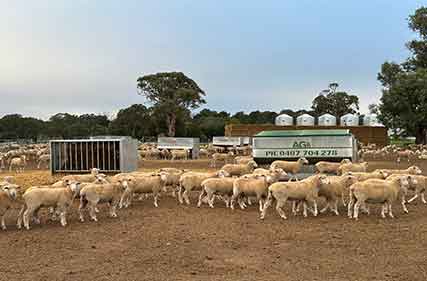
Lambs in the on-farm feedlot at the Kelly family property at Rugby are sold over the hooks at 30kg carcase weight. Image Dougal Kelly
The lessons learnt by livestock producers on confinement feeding and forage conservation in the drought were under the spotlight in Wagga this month.
Nutritionist Dr Ian Sawyer led a panel session on the innovative ideas and experiences of southern NSW and Victorian farmers during the 2024/2025 drought at the Pasture Agronomy Services conference on March 10.
Producers Dougal Kelly, Rugby, Lach Harris, Wagga, Matt Reynolds, Grahamstown and Matt Tonisson, Hamilton, joined Michael Savili, Lallemand Australia, and Jon Meggison, sales and marketing manager, AusFarm Nutrition Products, to step through silage production, economically feeding mature cows in a drought lot, feed bunkers and lamb feedlots.
Lach Harris outlined how he maintained mature cows in drought lots for 10 weeks using a simple, low labour system of a single high tensile wire electric fence to contain the cows and corn fed underneath. The roughage base was straw or silage bales.
A total of 3.79kg/day of corn was fed to the cattle, along with 3.57kg/day of straw for a total cost of $2/head. This was increased in late pregnancy to give 80 megajoules of energy per day per cow at a cost of $2.46/head.
“By April 2025 our cows were in light condition without a lot of selvedge value, so it seemed like a good idea to feed them through rather than destock. All the light cows went on the hill country while 80 per cent went into the containment paddock,” Mr Harris said.
“We had no forage conserved so we bought five weeks’ worth of corn and straw and chose sites with good water for containment areas around the farm.”
Powered by solar electric fence units, the containment pens catered for 200 mature cows each and feeding consumed one labour unit for 15 hours a week.
Take home points for Mr Harris was to allow at least one metre of fence line per cow when feeding grain; the mob size of 200 head worked well; and the paddock sizes were 2-6ha.
He said the smaller 2ha paddocks became boggy in winter.
“Feeding on the low side of the fence caused bogging under the fence at the feed line,” he said.
Matt Reynolds aimed to have a controlled drought strategy using forage conservation and invested in a large concrete bunker for chopped silage on his Grahamstown farm.
He had conserved silage in dirt bunkers each year after the millennial drought but found the quality was compromised so moved to concrete bunkers to avoid contamination.
The large bunker is 11m x 28m x 2.2m high, has a capacity of 470 tonnes and a total cost of $125/cubic metre.
“We are keeping our best quality silage for our weaners – I still use wrapped silage bales in the yards at weaning and then feed the chopped silage into troughs,” Mr Reynolds said.
He said the concrete feed troughs were located close to the silos and straw, and provided all weather access, and less contamination and wastage.
“The key is having the silage well compacted and sealed. It is quick to feed out if high quality, it mixes quickly as it’s already chopped.”
Knowing he has quality feed to get the weaners through autumn is a comfort for Matt, as he is not having to sell cattle during depressed prices.
“I am building a long-term feed reserve underground in good years that is mouse and fireproof, and am in control of the quality,” he said.
Michael Savil, Lallemand Australia, said the benchmarks around making good quality silage included retaining around 92 per cent of the original harvested material.
“Air is the enemy of silage – grass plus air equals compost. When working with bunks and we get a really good roll, there is still about 32 per cent of air in that bunk, and with air comes challenge,” Mr Savil said.
Dougal Kelly, Rugby, established an on-property lamb feedlot in 2023 when the store market collapsed.
“We had a desire not to sell any of our store lambs but finish them. I looked at automated systems, and we decided to go to a lower cost system using sheep feeders, Conron concrete troughs and hay,” Mr Kelly said.
“Our main issue was creating a system for our team that regulated how we fed every group of lambs coming through.
“We started all the lambs on oats to remove any room for error, and we were able to get consumption up quickly.”
The lambs were then moved onto a purchased feedlot blend to remove any mixing issues.
The family saw the lamb feedlot as an opportunity to expand the system by sourcing outside store lambs, backgrounding them on pasture before feedlot entry in autumn and winter on a rising market.
“The biggest issue we had was creating the same health treatments for every purchased store lamb, before backgrounding for two weeks. They are monitored and introduced to grain in paddock feeders, eventually moving into the feedlot induction pens at 42kg liveweight,” Mr Kelly said.
Average daily weight gain is monitored and once the whole mob is consistently gaining weight, they are moved onto larger feeders to rapidly increase consumption.
Daily weight gains of up to 600 grams a day have been achieved, and all lambs are turned off to the supermarket trade at 30kg carcase weight.
Mr Kelly said buying the store lambs of proven genetics at the right time and induction best practice increased the feedlot’s profitability.
Labour has been reduced through an investment in chaser bins, larger feeders and creating more pens.
-Kim Woods