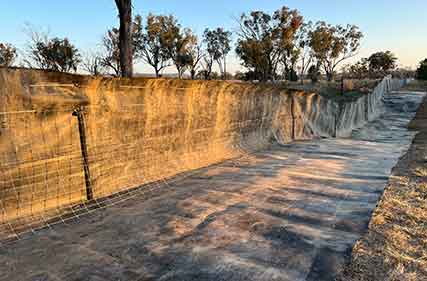
Flood gates and exclusion fencing on Allen family’s Bingara property.
Pest exclusion fencing has enabled a northern NSW family to take advantage of cropping and agistment opportunities to increase on-farm profitability and productivity.
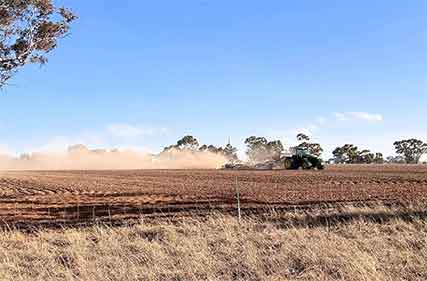
Michael and Christine Allen’s cropping and beef enterprise at Bingara had experienced constant pressure from invading feral pigs and kangaroos, damaging crops and fencing.
The arable cropping areas on their property “Luton Hoo” was particularly Impacted by the pest animals living in and around their native hill country, resulting in huge grazing pressure on cereal crops.
“Three hundred metres around the crops would be wiped out,” Mr Allen said.
“Our total grazing pressure was intensified during dry years and our fodder crops attracted feral and native animals from afar.
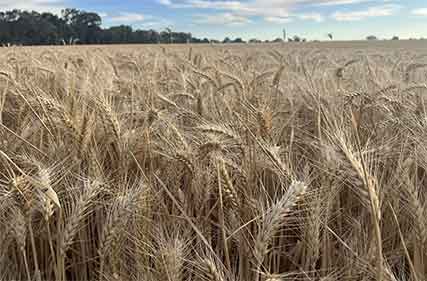
“We identified a third of our country as suitable for fodder and cash crop production and excluded all unwanted pests from that area”
The family has been able to stop kangaroo harvesting and protect the emu population on two thirds of the property.
Mr Allen was a guest speaker at the Pasture Agronomy Service conference in Wagga Wagga on March 9-10.
He outlined how he organised a road trip to Queensland to study the best exclusion fencing designs.
The Allens erected 12km of exclusion fencing around their cropping country with the effects being felt immediately. The family were able to agist heifers on a failed soybean crop, an income opportunity they had never been able to access.
The fence used high tensile Waratah Stockgrip15/150/15 exclusion fencing and high tensile 2cm Longlife Blue barbed with an apron on the upside.
The long-lasting end assemblies were recycled gas industry drill stems and required no concreting. The foundations were the same depth as the fence height. There was no salvage wires used.
The running posts were 240cm Waratah Blue Latch, while every seven metres is a 270cm Waratah Jio MAXY star post. Flood gates used recycled gas industry PVC dam liner suspended on cables.
Some gateways were placed in corners to muster out native animals and gates were the same height as the fence at 180cm.
“To put this in perspective, with current land prices in our district at around $3500 per acre, it cost us $100 per acre to enclose our land. It has been a real game changer for us,” Mr Allen said.
“We are able to wean the cattle with the sale cattle grazing inside the exclusion fence.”
The family runs Angus, composite and Drakensberger cattle, an indigenous South African breed known for its smooth coat, long and deep bodied medium to large, framed cattle.
The maternal breed emphasises calving ease, fertility, milk, docility, longevity, and above average weaning weights.
Black Cape cattle were purchased from Dutch settlers by the First Fleet. These cattle were Sanga Bos taurus African native cattle and were eventually called Drakensberger, the first cattle to land on the Australian continent.
The Allen family run 600 Angus and composite breeders and 50 purebred Drakensberger females.
“I have used Sanga genetics over Angus cows since 2006 and Drakensberger genetics since 2011,” Mr Allen said.
“Twenty-five per cent Sanga genetics will give an animal the traits we need, heat tolerance, disease and parasite resistance. We are concentrating on polled genetics.
“We produce adapted Angus bulls to lift carcase quality when used over Bos indicus herds in northern Australia.
“More than 200 of our bulls have been sold in North Queensland to a Hughenden family to breed flatback progeny suitable for lot feeding in southern Queensland.
“Sanga cattle marble well off grass and have the slick coat gene. The Africana, a Sanga breed, was used by the Belmont Research Station in the 1970s to develop the Belmont Red breed.”
-Kim Woods