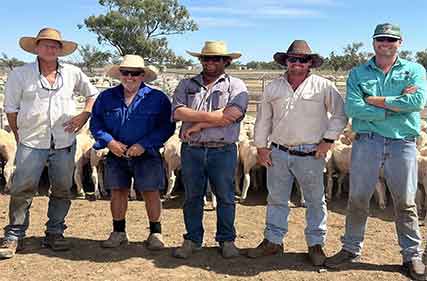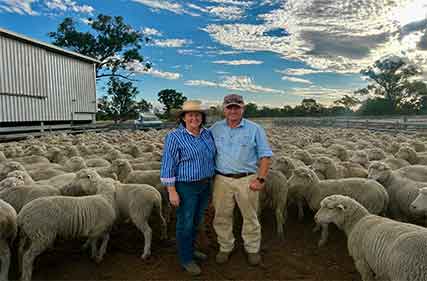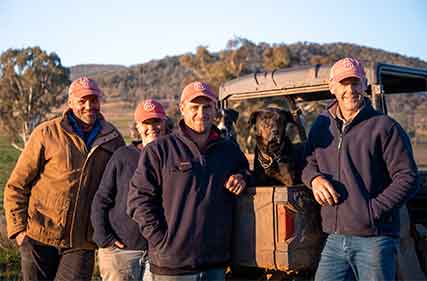
Mumblebone principals Chad and Lou Taylor with Ed Johns, farm manager, and Josh Walters, operations manager. Image Ben Simpson
A leading NSW Merino flock has taken on the world’s most demanding animal welfare, environmental and social standards to snare a direct supply relationship with global brand, icebreaker.
Chad and Lou Taylor, Mumblebone Merinos, secured a 10-year contract to supply 100 bales of best fleece wool from their 300-bale clip to the natural performance apparel brand in a first for an Australian wool grower.
The contract was brokered by Zentara Wool Company, formerly New Zealand Merino, opening the way for other Australian Merino flocks.
The Taylors run 1600 DNA tested stud ewes, averaging 19 micron, and 4000 commercial ewes on 4000ha freehold and 400ha leased land at Wellington, in central western NSW.
Mumblebone genetics can now be found in more than 200 postcodes around Australia and New Zealand.
Zentara chief executive officer Angus Street said the contract with Mumblebone reflected increasing interest from global brands in trusted relationships with Australian Zentara Quality (ZQ) certified wool growers.
ZQ has set global benchmarks for animal welfare, environmental stewardship and responsible farm management since 2006.
icebreaker began establishing long term partnerships with NZ merino wool growers in 1997 and partnered with Zentara in 2022 to transition to regeneratively grown wool.
Smart Wool and icebreaker Global President Jam Van Mossevelde said Australian ZQ-certified growers produce some of the finest Merino wool in the world.
“Their responsible approach to wool is a key reason we choose to partner with them,” Mr Van Mossevelde said.
The path to securing the deal was not an overnight sensation for the Taylors who have fulfilled two three-year contracts through New Zealand Merino in the past to supply brands including Smart Wool and icebreaker.
Chad Taylor said up until now there had been no contracts beyond three years offered to Australian growers.
“These relationships have reached a point where there is enough confidence to offer a contract that lasts for 10 years – that’s the sort of relationship that excites us and we look to keep building within the industry,” Mr Taylor said.
“There is still some volatility in the market we are exposed to with the shorter-term contract but once we get out to 10 years, that volatility is near enough neutralised, and there is a premium paid on top of that.”
The ZQ certification goes beyond animal welfare to include the ecological and social aspects.
“Once we have that certification met it gives confidence to the brand, in this case icebreaker, to take on the wool and offer a long-term contract to the clients and growers to ensure supply is shored up from both ends,” Mr Taylor said.
“Mumblebone is a gateway to what our clients are doing – we are breeding a sheep that genetically meets the certification criteria across animal husbandry, particularly mulesing. When we breed a sheep that doesn’t need to be mulesed we open the door to meeting the specs of this certification.”
On-farm changes at Mumblebone to gain ZQ certification included modifications to the shearing and chemical sheds.
The Taylors deliberately set a clear path to build the modern genetic platform they have today.
The couple uses measurement and data collection to reinforce breeding decisions for the stud and client’s flocks.
Mumblebone balances a high value fleece across an animal with industry leading growth rate, condition score and reproduction refined with worm and dag resistance to produce a profitable, easy-care animal.
By aligning production goals with welfare needs, doors are opened to faster growth, higher reproduction, longer staple length and lower fly pressure – all traits to keep the customer and bank manager happy, according to Chad.
“We want to increase the fleece value over time on an animal that is better set to meet the needs of the future. To me that includes condition score, growth rate, bare breach, low dag and worm pressure – all of those factors are efficiently combined when we have the data to select on,” he said.
The early growth and condition score results in stud ewes capping out at a moderate adult weight of 65kg liveweight, giving a stocking rate advantage per hectare.
“Our mature ewes have a 10 per cent fleece weight to body weight ratio of 6.5kg annually while our two-year-old ewes are cutting 5.2kg with a body weight of 52kg,” Mr Taylor said.
He uses feedback from his end use customers to focus on staple length, especially on a six-monthly shearing.
“If there is a setback for the ewes they may fall below the staple length minimum requirement. Selection for staple length is important for us to ensure we are meeting that length target in six months.
“The wool is slipping straight into the specs required for quality in terms of wool colour and coefficient of variation of fibre diameter.”
Zentara’s Angus Street confirmed several other leading Australian growers are also considering long term agreements with icebreaker.
“This 10-year contract opens the door to giving people confidence to start investing in the wool industry,” Chad Taylor said.
“We have brands looking to build these relationships and that needs to be supported from the grower end by breeding an animal and producing a fibre professionally classed and prepared to meet the specifications the brands are looking for.
“With that relationship in place, it paints a picture that gives people confidence about the wool industry.”