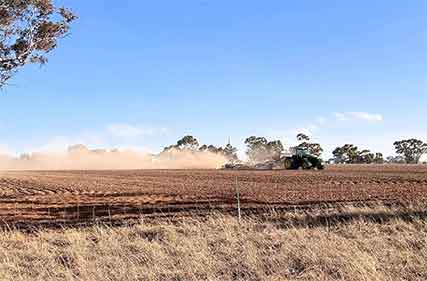
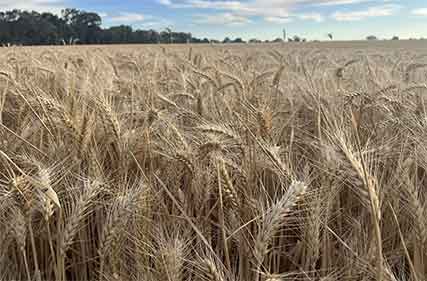
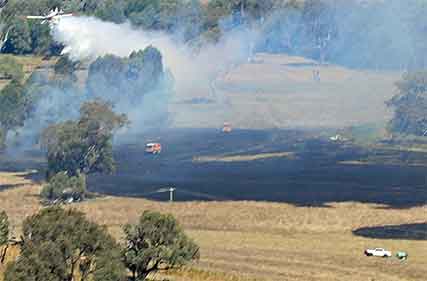
 Fire affected farmers in northern and central Victoria have benefited from donated seed to oversow new pastures to help fill their autumn-winter feed gaps.
A prize of a fly-fishing trip for four mates was auctioned at the Pasture Agronomy Service conference at Wagga Wagga in March, with the successful bidder at $4000 being DLF Seeds.
Sam Jarrett, DLF Seeds sales agronomist central and south west NSW, decided to convert the prize into $4000 worth of Economax pasture seed for those farmers burnt out in the January 2026 Victorian bush fires to oversow affected paddocks.
The seed mix contains Saia oats, Italian ryegrass and annual ryegrass for quick, autumn feed and a spring flush with the ability to make hay.
The fire affected PAS clients were the Houston family, Houston Pastoral, Burrowye; David and Tara Brewer, Brewer Beef, Tallangatta Valley; and Jarrod McKay, Larnoo Pastoral, Yea.
There was additional support via a donation from SIPCAM, represented by Chris Fletcher, Dubbo.
Graham Houston said the seed donation was welcome at his family’s Burrowye Station which lost pasture and fencing in the fires and a devastating flood that followed. While buildings were saved, much of their cow herd was left without pasture and was lifted north to stock routes.
“The seed is in the ground and up now with the best autumn start in 30 years with 150mm in March/April – we appreciated that,” he said.
“We have 20 B-double loads of cattle with drovers near the Queensland border and they are now coming home with the flush of grass. We are appreciative of the timely support by forestry management fire crews with earth moving equipment and helicopters.”
Pasture Agronomy Service principal Mark Lucas said all of the fire zones had benefitted from recent rain, making it ideal for oversowing new pasture.
He was quick to contact and visit producers after the event to walk them through a program of pasture renovation.
“The intensity of a fire can be judged by cow manure – if a dry cow pat is burnt to ash, it was an intensely hot fire, burning down into the seed bed. With all of those farms visited, there was no cow manure left in the paddocks,” Mr Lucas said.
“Any grass seed and perennial grass crowns were burnt down into the ground, but it doesn’t have much effect on sub clover. Quite often heat near a sub clover seed will make it break dormancy quickly and this can lead to excessive clover post-autumn break.”
Mr Lucas said many producers had already sown oats for quick feed while others have sown Economax, a mixture of Saia oats, tetraploid ryegrass, and hybrid Italian ryegrass to fill the autumn winter feed gap.
“They need balance on those areas where the clover will return ferociously, resulting in bloat in cattle in early spring.
“The weeds will be mainly broadleaf varieties, and they can be knocked down later.”
When it comes to burnt fencing, Mr Lucas said there would be opportunities to reconfigure laneways for ease of stock management.
Sam Jarrett agreed, saying growing quick ground cover was key post bush fire to make use of recent rain.
“Oats and ryegrass would give quick, quality feed for cattle going into autumn,” Mr Jarrett said.
“The opportunity to reconfigure paddocks into smaller cells gives better grazing management. If producers had old pastures, it is also an opportunity to renovate with new, improved genetics.
“There is 25 to 30 years of work that goes into the release of a single new pasture variety, and these new genetics are built to last.”