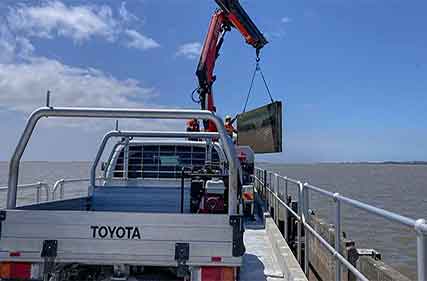
Removing concrete stop logs from the barrages, allowing water to flow between the lower lakes and Coorong areas.
The historic opening of all the operational barrages near the Murray Mouth in South Australia means the River Murray is now free flowing all the way from the Yarrawonga Weir to the sea for the first time in decades.
More than 570 operational bays across the five barrages – Goolwa, Mundoo, Boundary Creek, Ewe Island and Tauwitchere – have been opened because of the high volume of water in the river flowing to the Lower Lakes, Coorong and Murray Mouth.
It is believed to be the most significant barrage opening since the 1970s. Around 400 of the barrage bays were opened during a high flow event when the Millennium Drought broke in 2010/11.
South Australia’s Engineering and Water Supply Department built the barrages in the 1940s to maintain water levels and water quality in the Lower Murray, with the costs of construction shared between South Australia, New South Wales, Victoria and the Commonwealth.
The Murray–Darling Basin Authority’s Executive Director of River Management, Andrew Reynolds, says while the 2022 flooding had left many Basin communities and businesses seriously impacted, it presented an opportunity to deliver unregulated flows through the river system to the sea. The opening of the barrages follows the removal of each weir in the river all the way to Yarrawonga almost 2,000 kilometres upstream.
“Our thoughts are with those suffering as a result of the flooding,” he says.
“It has been a long time since the complete opening of all barrage bays, and logistically it has been an enormous exercise as only a small number of the bays are automated. Most of the barrages were opened onsite by SA Water using specialist equipment.”
In dry years of low water availability, barrage releases are limited and are supported by environmental water recovered under the Murray–Darling Basin Plan. In wet years, the barrage gates are opened to reinstate continuous connectivity between lakes Alexandrina and Albert and the Coorong.
Creating a free-flowing river from Yarrawonga to the sea, the opening of the 5 barrages and the subsequent flow was delivering other important benefits for the Murray system.
“We have been able to stop the dredging of sand at the Murray Mouth. The flows through the barrages are helping to make the Mouth much wider and deeper, and we’re hopeful that as a result of this scouring event we may not have to dredge the Mouth for several years,” says Andrew.
“Floodplain vegetation that hasn’t had a drink for a long time is now being watered – some for the first time since the 1970s. Black box trees and river red gums at the margins of floodplains that have been struggling in recent years are now getting a life-saving drink that will set them up for the years ahead.
“This is also flushing a lot of salt out of the system, which is an important objective under the Murray–Darling Basin Plan to improve long-term water quality.”
MDBA Regional Engagement Officer Kate Bartlett, who lives near Murray Bridge in South Australia, says she was at the barrages watching on as the final gates were being removed.
“It’s a great sight to see,” says Kate.
“The local community was made aware the barrages were going to be fully opened. It does mean that if there’s a high tide or strong southerly or westerly winds, the salt might blow in a little. But it will soon be flushed back out through the Mouth.
“Normally there are only a small number of the barrage gates open, so you get large gatherings of birds and seals at the fishways. Now they have the whole waterway available to them. You can also see the Murray Mouth being scoured especially on the Goolwa side because the water flowing through the Tauwitchere barrage is so fast.”
-Murray Darling Basin Authority